Overtones
Acoustic sound consists of a fundamental tone alongside accompanying partial tones. The fundamental frequency is typically the most prominent, establishing whether a note sounds like G or D. For most musical instruments, these partial frequencies align with harmonics—integer multiples of the fundamental frequency. The first harmonic partial corresponds to twice the frequency of the fundamental, while the second harmonic is three times that frequency. Additionally, the third, fourth, and fifth overtones combine to form a major triad.
Certain partial tones have transient durations and lack a fixed hierarchical structure, which the human ear generally perceives as noise. These elements shape the unique timbre and character of a sound or instrument, including qualities like attack, resonance, and airiness. Instruments such as cymbals and drum heads generate numerous inharmonic partials without defining a distinct pitch.
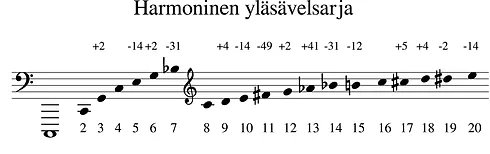
Harmonic series based on a fundamental tone "C". Upper numbers show the tuning offset compared to equal tuning
Sources:
Laaksonen, J. 2006.
Yvert, J-P. 1996.
© Janne Ojajärvi