How to play
How the overtone flute works?
Beginning your journey with the overtone flute involves exploring the unique sounds and intonation patterns of the instrument. Because it relies entirely on breath pressure and the manipulation of the open end, the resulting scale can initially sound distinctive. Adjusting the strength of your air stream—ranging from a gentle warmth similar to breathing on cold hands for lower notes, to focused, firmer airflow for higher partials—allows you to navigate through the harmonic series.
Controlling the open end with your finger also enables intermediate sounds between fully open and closed positions. Articulation can be shaped using tongue and throat techniques to alternate smoothly between legato and staccato phrasing, adding musical expression to your playing.
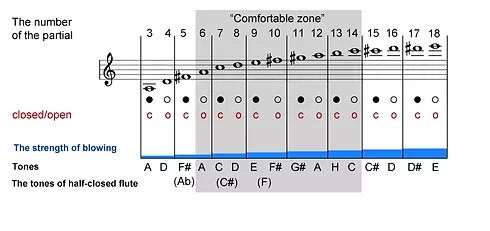
Overtone scale and partials overview
Listening closely to the overtone scale helps your ear adapt to its characteristic tuning. Over time, physical touch and response will vary depending on the specific flute—some instruments favor higher registers while others excel in lower tones. Because traditional acoustic dynamics like standard forte and piano markings cannot be directly applied through breath alone, musicians utilize ornaments, tremolos, attack variations, and rhythmic patterns to create dynamic texture and expression.
Join the Global Overtone Flute Community
Stay updated with the latest willow flute tutorials, sheet music releases, and stories from the Finnish woods. Subscribe to the newsletter to receive resources directly in your inbox.
© Janne Ojajärvi